The Operational Layer of AI: From Visibility to Control
A capable model can make an impressive prototype.
But once AI becomes part of a real business process, model capability is only one part of the problem.
An agent may retrieve information, call several tools, use different models, retry failed steps, and make decisions before producing a final result. When something goes wrong, the answer itself often tells us very little about what actually happened.
This is why an operational layer is emerging around AI systems.
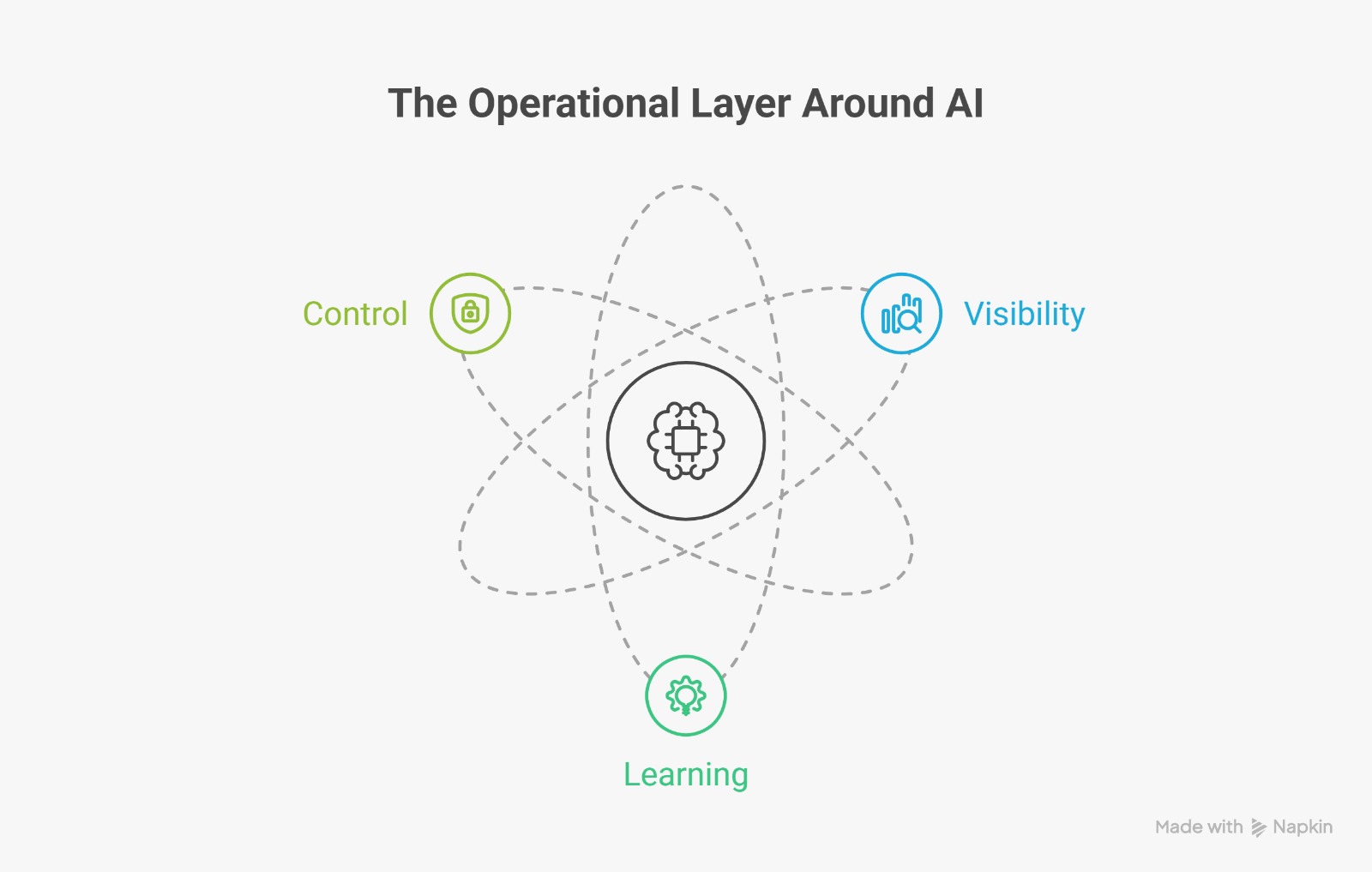
Tracing, evaluation, prompt management, cost monitoring, and LLM gateways are often discussed as separate technologies. In practice, they address three broader needs: visibility, learning, and control.
Understanding those layers is more useful than starting with a particular platform or tool.
Visibility: Understanding the Whole Workflow
Traditional application monitoring is good at telling us whether a request succeeded, how long it took, and whether an API returned an error.
AI systems introduce another question:
What actually happened between the input and the final answer?
A multi-step agent may retrieve the wrong document, choose an inappropriate tool, repeat a model call unnecessarily, or take an unexpected branch in the workflow. The request can still complete successfully from an infrastructure perspective.
Tracing makes that execution path visible.
Instead of looking only at the final response, teams can inspect model calls, tool usage, retrieved context, intermediate steps, latency, token consumption, and other parts of the workflow.
That changes the way AI failures are investigated.
If a customer-support agent produces a poor recommendation, the problem may not be the final generation. The agent could have based its decision on incomplete context several steps earlier.
If a research workflow becomes unexpectedly slow, tracing can show whether the delay came from retrieval, repeated tool calls, or an expensive model used where a smaller one might have been sufficient.
This is also where cost becomes more meaningful.
A provider invoice tells us how much model usage cost in total. It does not explain which workflows generated that cost or whether the spending produced useful outcomes.
When cost is connected to traces, teams can start asking better questions: Which part of the workflow is expensive? Are retries creating unnecessary calls? Does using a larger model at a particular step actually improve the result?
The useful metric gradually shifts from cost per token toward cost per successful outcome.
Learning: Turning Production Experience Into Better AI
Visibility is useful, but collecting traces is not the goal.
The real value appears when production experience feeds back into development.
AI applications inevitably encounter situations that were not fully represented during initial testing: unusual customer requests, ambiguous data, weak retrieval results, unexpected tool behaviour, or edge cases that expose gaps in the workflow.
Those cases can become learning material.
A failed production trace can be turned into a regression example. A human correction can become evaluation data. A difficult request can be added to a dataset used to test future versions.
Over time, the system develops a library of situations that matter in the real world.
How do we know whether a change actually made the AI better?
This is where evaluation becomes important.
Changing a prompt, model, retrieval strategy, or workflow may improve one group of cases while making another worse. A more powerful model may increase quality but also increase latency and cost.
Evaluations make those trade-offs measurable.
The definition of quality depends on the application.
A research agent may need factual grounding and source relevance. A customer-service workflow may need correct policy interpretation. A document-processing system may care about extraction accuracy, while an operational agent may also need to be evaluated on whether it selected the correct actions.
The important part is that improvements are tested against representative cases rather than judged only by a few manually selected examples.
Prompt management fits naturally into this process.
Prompts often begin as strings inside application code. As the system matures, however, they start influencing significant application behaviour.
A small change can affect how an agent interprets information, selects tools, handles uncertainty, or formats recommendations.
That means prompts eventually need the same questions we ask about other important application changes.
Which version is running? What changed? Was it tested? Did quality improve? Can we restore the previous version?
Prompt management becomes valuable when prompt versions can be connected to traces and evaluation results. The prompt itself is not the interesting part. The important capability is being able to understand how a change affected behaviour.
In that sense, prompts gradually become versioned operational assets.
Control: Setting Boundaries Around AI Execution
Tracing and evaluation help teams understand and improve an AI system.
But some problems should not only be detected after they happen.
Consider an agent that enters an unexpected retry loop and starts generating hundreds of model calls.
Tracing can explain the cause. Cost monitoring can show the impact. Evaluation can help prevent the issue from returning.
But an organization may also want a mechanism that limits the behaviour while the system is running.
This is where runtime controls — and increasingly LLM gateways — become relevant.
A gateway creates a common control point between AI applications and model providers.
Instead of every application managing model access independently, some policies can be handled in one place: model routing, credentials, rate limits, budgets, provider fallbacks, or rules around sensitive information.
The distinction is important.
Observability explains what happened. Control defines what is allowed to happen.
For one small application using one model provider, a dedicated gateway may add unnecessary complexity.
The value grows when several teams, applications, and model providers are involved. At that point, model access starts becoming shared infrastructure rather than a collection of independent API integrations.
From Separate Capabilities to an Operating Model
Tracing, evaluations, prompt management, gateways, and cost monitoring can look like a list of unrelated AI features.
Together, they form a continuous operating cycle.
- The AI workflow executes.
- Tracing shows what happened.
- Production cases reveal where the system struggles.
- Evaluations turn those cases into measurable tests.
- Prompts, models, or workflows are improved and versioned.
- Runtime controls define the boundaries within which the next version operates.
- New production interactions generate another round of evidence.
Execute → observe → evaluate → improve → control → execute again.
This is more useful than thinking about the operational stack as a checklist of tools.
Not every AI application needs every capability.
A simple assistant may work perfectly well with standard logs and a small set of manual tests. A multi-step agent connected to business systems may require detailed tracing, repeatable evaluations, controlled prompt releases, cost visibility, and centralized model policies.
The infrastructure should grow with the responsibility of the AI system.
Making AI Operable
We have previously discussed the importance of building workflows and engineering structures around AI models.
The operational layer is the next part of that architecture.
As AI becomes responsible for longer workflows and more consequential decisions, teams need to be able to understand its behaviour, measure its quality, learn from failures, and define its boundaries.
The model provides the intelligence.
The workflow gives that intelligence a process.
And the operational layer makes the whole system measurable, improvable, and controllable.
That is what turns an AI capability into something an organization can actually operate.