AI-Ready Data Engineering: Building Foundations That Don’t Break in Production
- 02.05.2026
AI isn’t blocked by a lack of models anymore. It’s blocked by data foundations that were designed for dashboards, not decisions. As AI becomes part of how work gets done—approving exceptions, prioritizing customers, routing cases, forecasting risk, drafting responses, and increasingly acting through agentic workflows—the definition of “good data engineering” changes.
Traditional data engineering optimized for reporting: consolidate data, model it once, and refresh it on a schedule. AI engineering needs something different: context-rich, governed, and reliable data that stays trustworthy at inference time—even as sources change, policies evolve, and the business redefines what success means.
At QubitNexus, we call this shift AI-ready data foundations: centralized, integrated, and designed to support production AI—predictive models, GenAI/RAG, and agentic workflows—without turning operations into a guessing game. This post explains what changes, what to build, and our strategy for getting there.
Why AI forces a rethink of data design
For years, most data stacks were built with a simple goal: help humans make sense of the business. We built pipelines to consolidate sources, cleaned them up enough to report on, and shipped dashboards that people learned to interpret with context and judgment.
AI flips that model. Instead of data informing a human decision, data increasingly becomes the decision—powering recommendations, automating routing, predicting risk, and generating responses that move work forward.
When data is used that way, the old tolerance for “close enough” disappears. Inconsistent definitions stop being annoying and start becoming dangerous. Quiet schema changes, stale signals, and undocumented workarounds don’t just distort a metric—they can change what the AI does in production.
That’s why AI forces a rethink of data design: the foundation has to carry meaning, governance, and reliability as first-class requirements. In practice, “good data for AI” is less about volume and more about context, control, and confidence—built into the system from the start.
The 5 design shifts of AI-ready data engineering
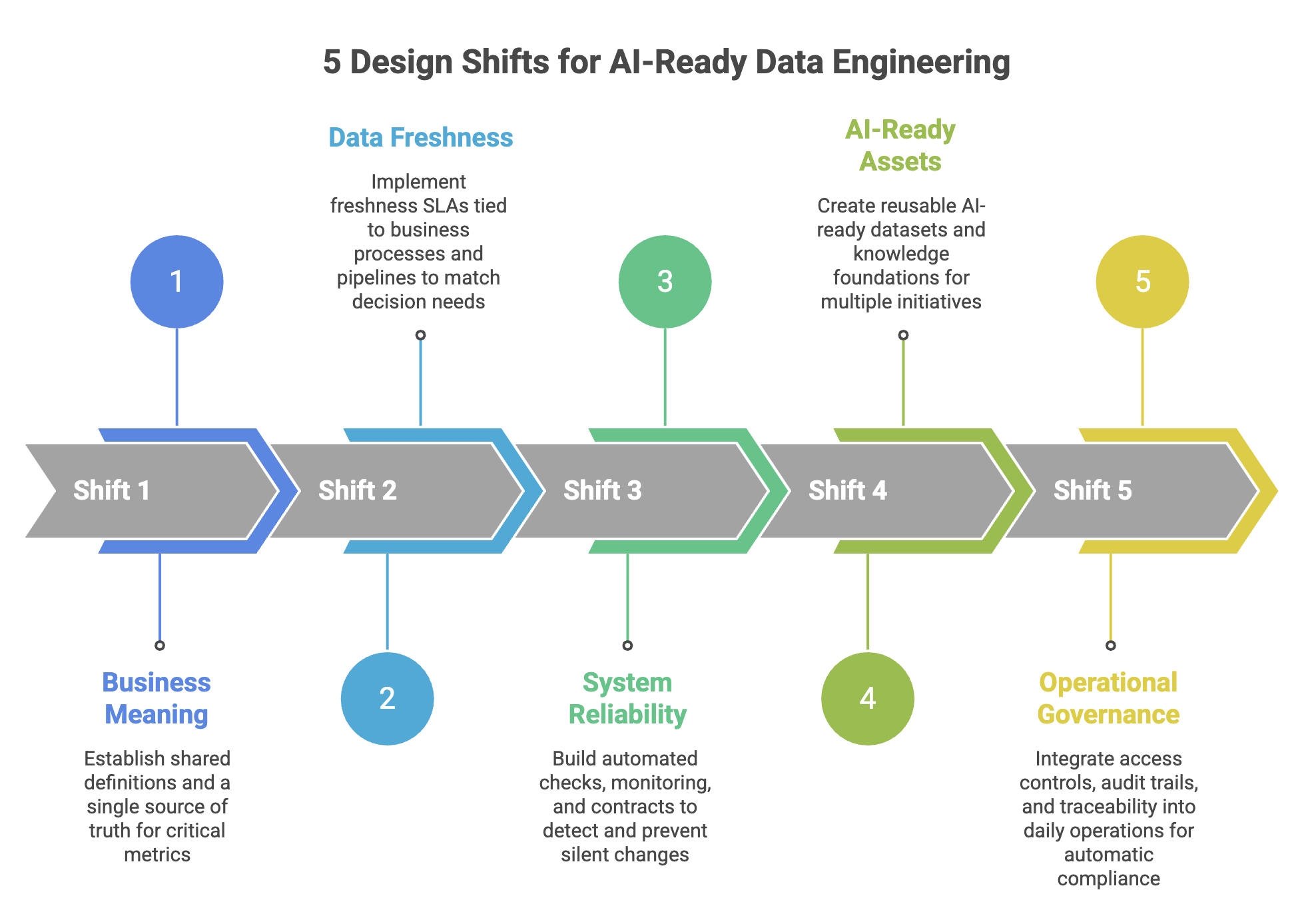
Each shift reframes what “good” looks like for data in production AI. Together, they mark the move from descriptive analytics to trustworthy AI outcomes.
-
From “data availability” to business meaning everyone agrees on.
AI can’t succeed if the organization can’t answer basic questions consistently. Shared definitions for critical metrics and entities become the single source of truth for how results are calculated—cutting conflicting numbers and raising trust in AI outputs.
-
From “daily refresh” to data freshness that matches the decision.
Not every workflow needs real-time, but fraud, staffing, collections, or customer escalations often do. We tie freshness SLAs directly to the business process so AI recommendations stay relevant.
-
From “pipelines that run” to systems that stay reliable when things change.
Silent schema changes or late feeds break AI behavior without tripping alerts. Automated checks, monitoring, and data contracts detect upstream issues early so they don’t become business incidents.
-
From “reporting data” to AI-ready assets.
Predictive and GenAI systems need curated training sets, trustworthy features, and governed knowledge bases. Reusable AI-ready assets prevent teams from rebuilding prep work for every use case.
-
From “governance as a project” to governance built into daily operations.
With GenAI and agents, leaders must answer: Where did that output come from? Who touched the data? Built-in access controls, audit trails, and traceability make compliance automatic instead of heroic.
The QubitNexus strategy: AI-ready data foundations
We don’t start with tools or architecture. We start with the business decisions AI is expected to improve—and build the foundation that makes those decisions reliable in production.
- Align on the AI outcomes that matter. Identify the highest-value AI use cases, define success metrics, map workflows, and surface trust gaps like inconsistent definitions or latency issues. Outcome: a prioritized roadmap tied to business impact—without boiling the ocean.
- Build a shared foundation that multiple AI use cases can reuse. Instead of one-off pipelines, we construct centralized, AI-ready foundations: consistent definitions, reliable integrations, high-confidence data/knowledge sources, and embedded governance. Outcome: faster delivery of new AI capabilities with less rework.
- Operationalize trust: quality, monitoring, and auditability. Put mechanisms in place to keep AI reliable as systems evolve—early issue detection, traceability from outputs back to sources, and scalable access controls. Outcome: leadership can trust AI in production because it’s explainable, monitorable, and governable.
The Building Blocks Behind Reliable AI
AI failures rarely come from the model—they come from what the model is fed. The goal of an AI-ready data foundation is to ensure the inputs are accurate, current, explainable, and compliant, whether the AI is predicting risk, powering a GenAI assistant, or automating a workflow. Here’s the simple blueprint we use to connect your sources to AI outcomes without introducing fragility.
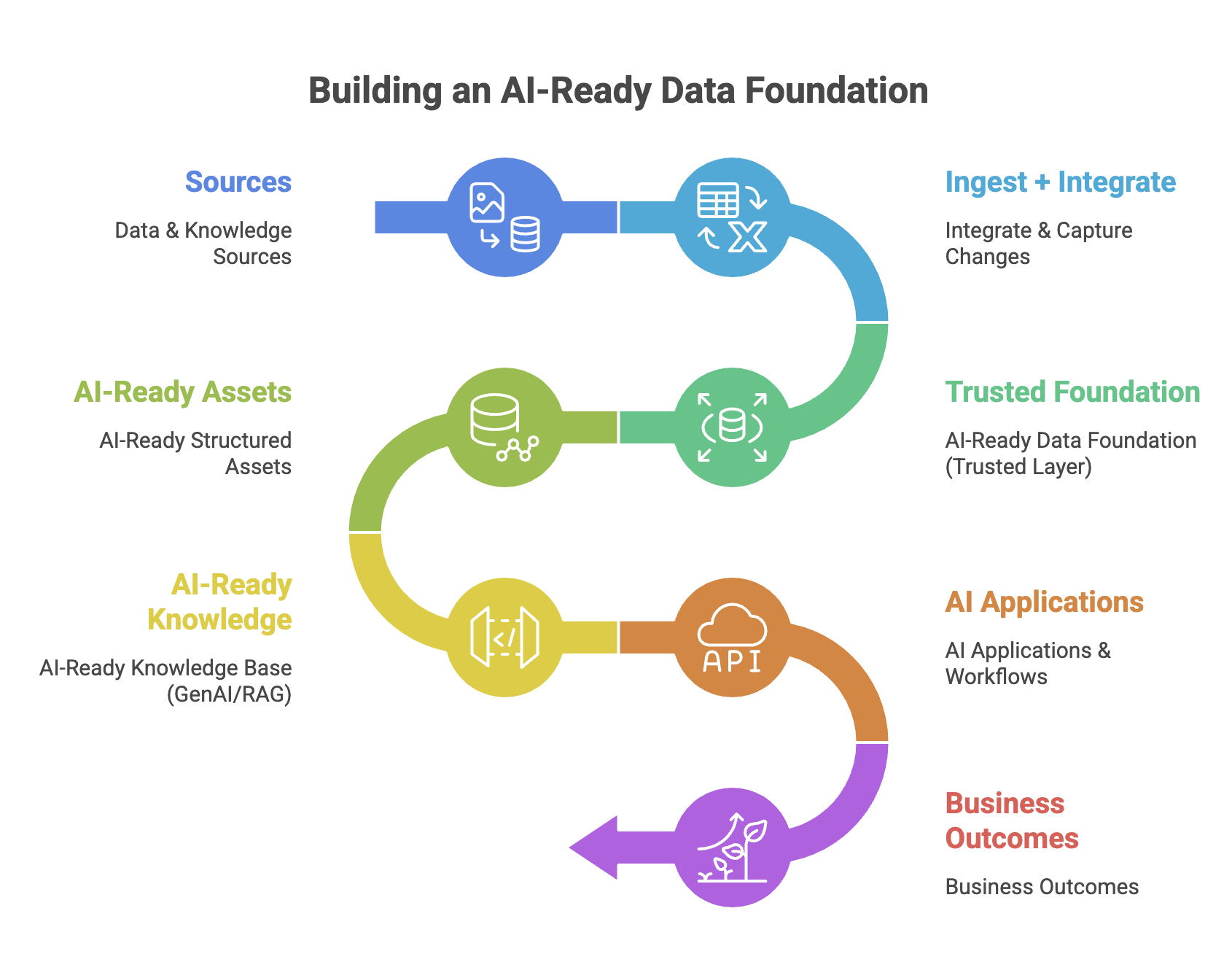
AI is only as reliable as the foundation beneath it. If you want AI that scales, you need data that’s consistent, current, governed, and explainable—by design. That’s what we build at QubitNexus: AI-ready data foundations that make AI work in production.
Sources & Further Reading
- NIST — AI Risk Management Framework (AI RMF 1.0)
- OWASP — Top 10 for Large Language Model Applications (2025)
- Microsoft Cloud Adoption Framework — Governance and security for AI agents
- Databricks — Six steps to improve your RAG application’s data foundation
- Databricks Docs — Build an unstructured data pipeline for RAG
- Azure Databricks — Improve RAG application quality
- OpenTelemetry — Documentation
- MLOps.org — MLOps Principles
- dbt — dbt Semantic Layer
- Monte Carlo — Data contracts explained