Why AI Agents Need a Wiki
- 06.09.2026
As organizations begin deploying AI agents across more business processes, most of the conversation focuses on intelligence. We talk about reasoning, planning, tool use, context windows, and autonomous workflows. The assumption is that if we make agents smart enough, they will naturally become more useful.
But intelligence is only part of the equation. The real challenge starts after an agent delivers its answer.
What happens to the knowledge generated during that interaction? What happens to the feedback provided by users? What happens to the decisions, corrections, exceptions, and lessons learned over time?
In most systems, the answer is simple: nothing. The interaction ends, and the knowledge disappears.
Organizations Do Not Run on Intelligence Alone
Human organizations have never relied solely on individual intelligence. Even the most experienced employees cannot remember every decision, every exception, every lesson learned, or every piece of context accumulated over years of operation.
That is why organizations build documentation.
We create wikis, playbooks, postmortems, decision logs, knowledge bases, and operating procedures. These systems allow knowledge to persist beyond a single conversation or project. More importantly, they allow knowledge to become shared rather than remaining trapped inside individual people.
When viewed through this lens, modern AI systems reveal an interesting limitation.
Many agents are excellent at generating answers, but surprisingly poor at creating institutional memory. They can analyze data, detect patterns, and explain findings, yet they often treat every interaction as an isolated event. The system may have access to historical information, but it rarely captures the outcomes of previous interactions in a way that continuously enriches future decisions.
This creates a gap between intelligence and learning.
The Missing Layer in Agentic AI
As AI agents become more deeply integrated into business workflows, organizations need more than a history of conversations.
They need a structured way to capture and organize what agents discover.
Imagine an agent investigating an unusual business event. It analyzes data, identifies potential causes, and presents a conclusion. A user reviews the result and explains that the event was actually caused by a planned campaign. The explanation is valuable because it provides context that the data alone could not reveal.
Today, that knowledge is often lost.
Tomorrow, the same situation may occur again, forcing both the user and the system to repeat the same reasoning process.
A more effective approach is to treat every significant interaction as a knowledge asset. The original question, the analysis, the user feedback, and the final decision become connected pieces of information that can be revisited and reused in the future.
Over time, these individual fragments begin to form something larger than conversation history. They become a living knowledge system.
From Documents to Living Knowledge
This is where the concept of an LLM Wiki becomes interesting.
Traditional wikis are designed around documents. Pages are created manually, linked manually, and maintained manually. They are valuable, but they often struggle to keep pace with how quickly modern organizations generate information.
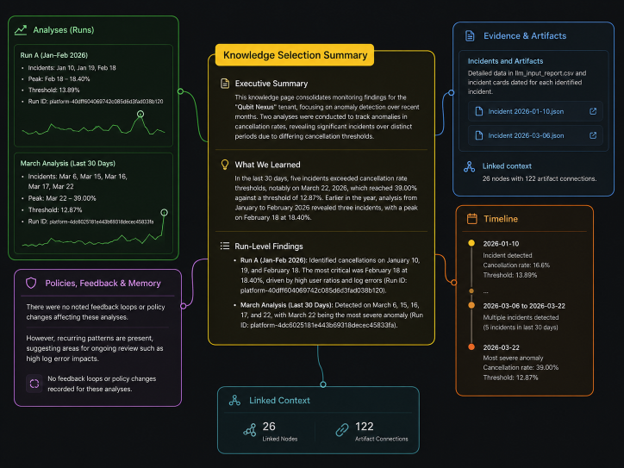
AI systems create an opportunity to rethink that model.
Instead of asking people to continuously document everything, agents can automatically generate and maintain knowledge artifacts as part of their normal operation. Questions become pages. Decisions become pages. Feedback becomes pages. Summaries become pages. Relationships between them are created automatically.
The result is not simply a collection of documents. It is a continuously evolving representation of organizational knowledge.
More importantly, it captures not only outcomes but also context.
A future user can understand what happened, why it happened, who provided feedback, what lessons were learned, and how those lessons influenced future decisions.
That context is often more valuable than the answer itself.
Why Knowledge Graphs Matter
Once knowledge is represented as connected entities rather than isolated documents, visualization becomes much more powerful.
A traditional wiki encourages users to search for information they already know exists. A knowledge graph encourages exploration.
Instead of reading a single page, users can navigate relationships between events, decisions, feedback, summaries, and policies. They can move from a high-level overview to the details of a specific decision. They can trace how a particular insight influenced future actions across the organization.
At first, that graph can look messy because real organizational knowledge is messy. Exceptions, lessons, decisions, and feedback do not arrive in clean categories. The value is that the graph makes those relationships visible enough to inspect, refine, and reuse.
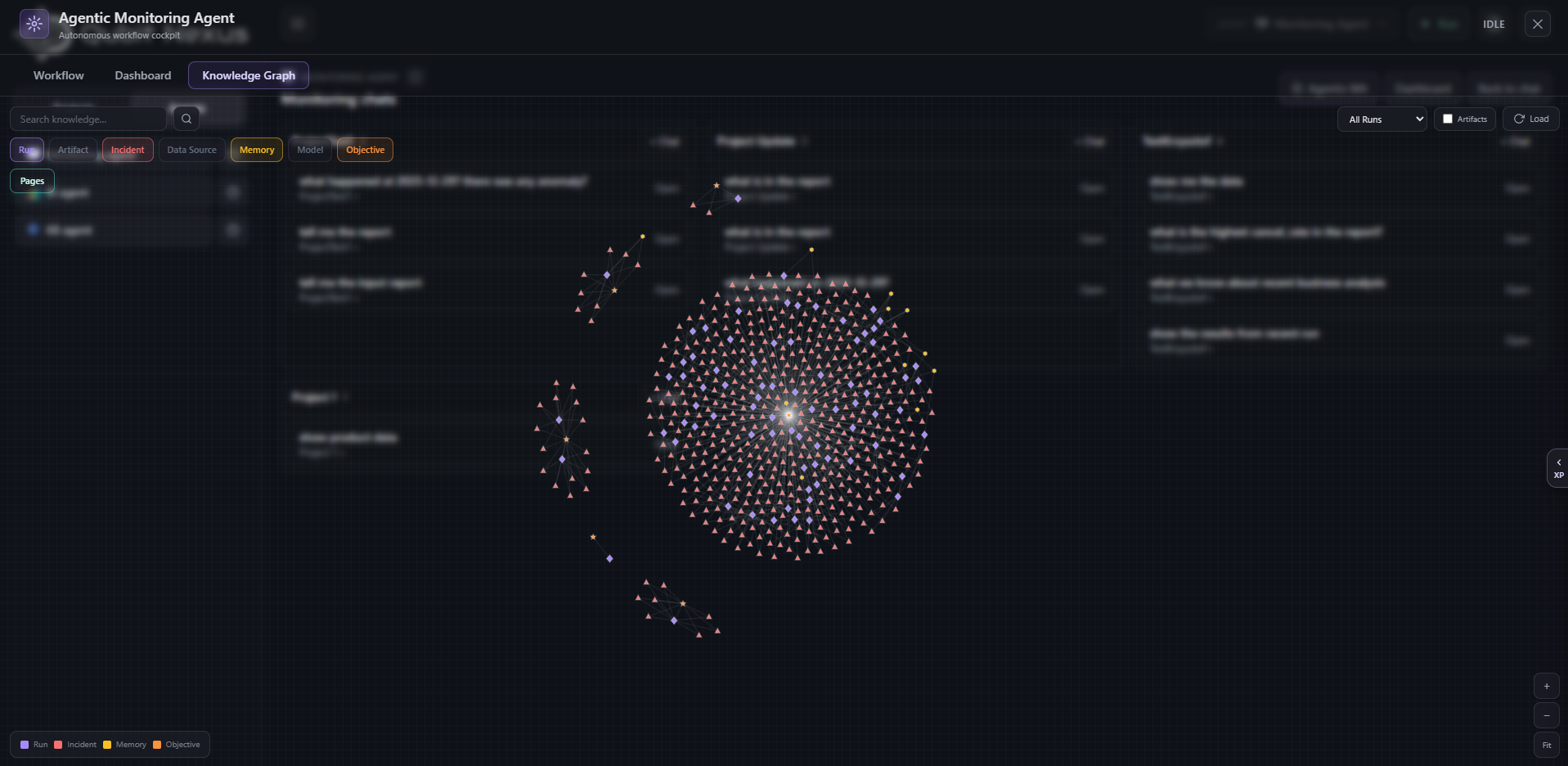
The graph is not the destination.
It is the interface that allows people to understand how knowledge evolves over time.
This distinction is important because the ultimate goal is not visualization for its own sake. The goal is to make organizational learning visible.
The Future of Organizational Memory
For years, enterprise software has focused on storing information. AI is pushing us toward a different objective: capturing understanding.
The most valuable AI systems of the future may not be those that generate the most sophisticated answers. They may be the systems that do the best job of preserving and organizing collective knowledge.
In that world, AI agents become more than assistants. They become contributors to an evolving organizational wiki that grows with every interaction, every decision, and every lesson learned.
Perhaps the next major breakthrough in AI will not come from larger models or more powerful reasoning.
It will come from giving AI something organizations have relied on for decades: a place to remember.