Beyond the API: How QubitNexus Customizes AI Systems That Actually Work
- 02.26.2026
Almost every company can access powerful models through an API today. That’s no longer the differentiator.
What does differentiate is whether you can turn that raw capability into a reliable, cost-aware, and operationally safe system that fits a real business workflow—one that people can trust day after day.
At QubitNexus, we’ve found that “AI customization” isn’t primarily about picking a model. It’s about engineering the right system around the model: decomposing the problem, placing AI where it adds leverage, and pairing it with deterministic pipelines, validation, and human review where precision matters.
Here’s our practical playbook.
1) Start with the simplest thing that works
Before reaching for RAG, fine-tuning, or “agent” orchestration, we always start by proving a baseline:
- Can a strong off-the-shelf model do the task well enough with a clean prompt?
- Can we get stable results with structured formatting?
- Do we understand the failure modes on real examples from your business?
This “keep it simple” approach prevents overengineering and gives you clarity about what customization is actually required—if any.
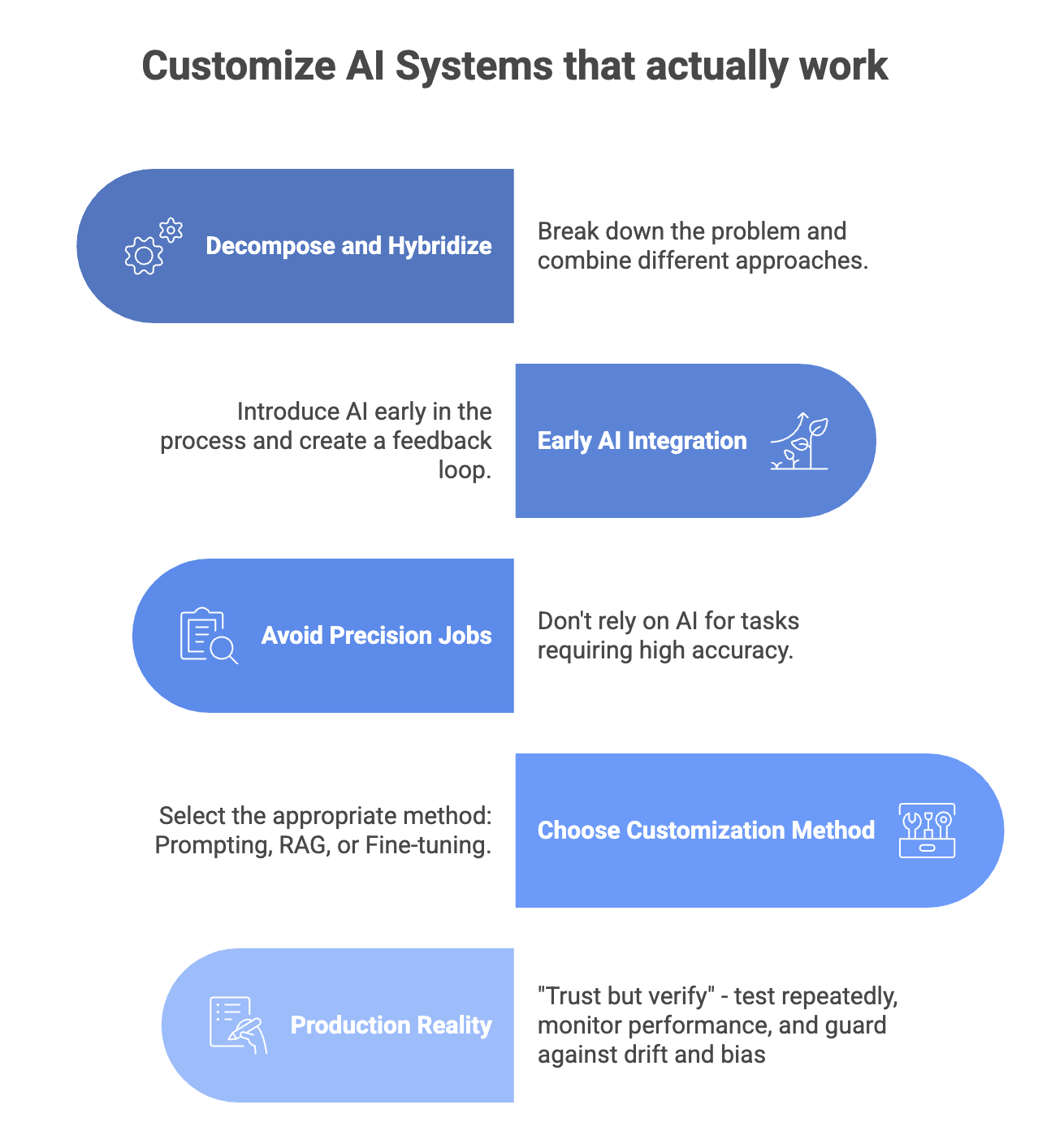
2) The #1 best practice: Decompose the problem and hybridize the solution
If you’re building an AI solution end-to-end, the fastest way to get burned is to treat the model as the whole system.
Instead, we recommend treating AI as one component inside a workflow, and decomposing the problem into smaller subtasks. Then assign each subtask to the best tool. This hybrid approach is how you get reliability without losing the acceleration benefits:
- Deterministic / traditional systems: handle the “hard guarantees” parts: data pipelines, rules, calculations, validation, and audit-ready monitoring.
- AI systems: handle the “language + judgment” parts: drafting and summarizing, extracting structure from text, routing and classifying, translating formats, and explaining outcomes.
3) Put the AI early, not late (and build the “catch + correct” loop)
A principle we use constantly:
Use GenAI earlier in the workflow to create candidate structure or drafts, then validate downstream with deterministic checks and/or human review.
- If AI hallucinates late in the process, it can contaminate downstream systems and become hard to detect.
- If AI produces an early draft or extraction, you can validate and correct it, request a retry or route to human review.
A practical “catch and correct” pattern
- AI generates a candidate output (draft, extraction, classification)
- Deterministic validators check formatting, completeness, and business constraints
- Grounding checks confirm that claims match known data (or retrieved sources)
- Human-in-the-loop review for high-risk cases
- Logging + feedback captured for iteration
This is how you ship GenAI responsibly in real operations.
4) Don’t ask GenAI to do “precision-required” jobs end-to-end
In many deployments, teams can quickly reach something like 80% performance with basic prompting. With better structure and examples, they can often reach 90–95%.
But the “last 5%” is where projects stall—especially when the task requires strict correctness, like converting between formal structures (policy → logic → code), or generating outputs that go directly into automated decision systems.
When near-perfect accuracy is required, we rarely recommend forcing the model to do the full transformation by itself. We redesign the workflow:
- break the task into smaller steps,
- use deterministic components where correctness is non-negotiable,
- and keep AI on the parts where approximation is acceptable and reviewable.
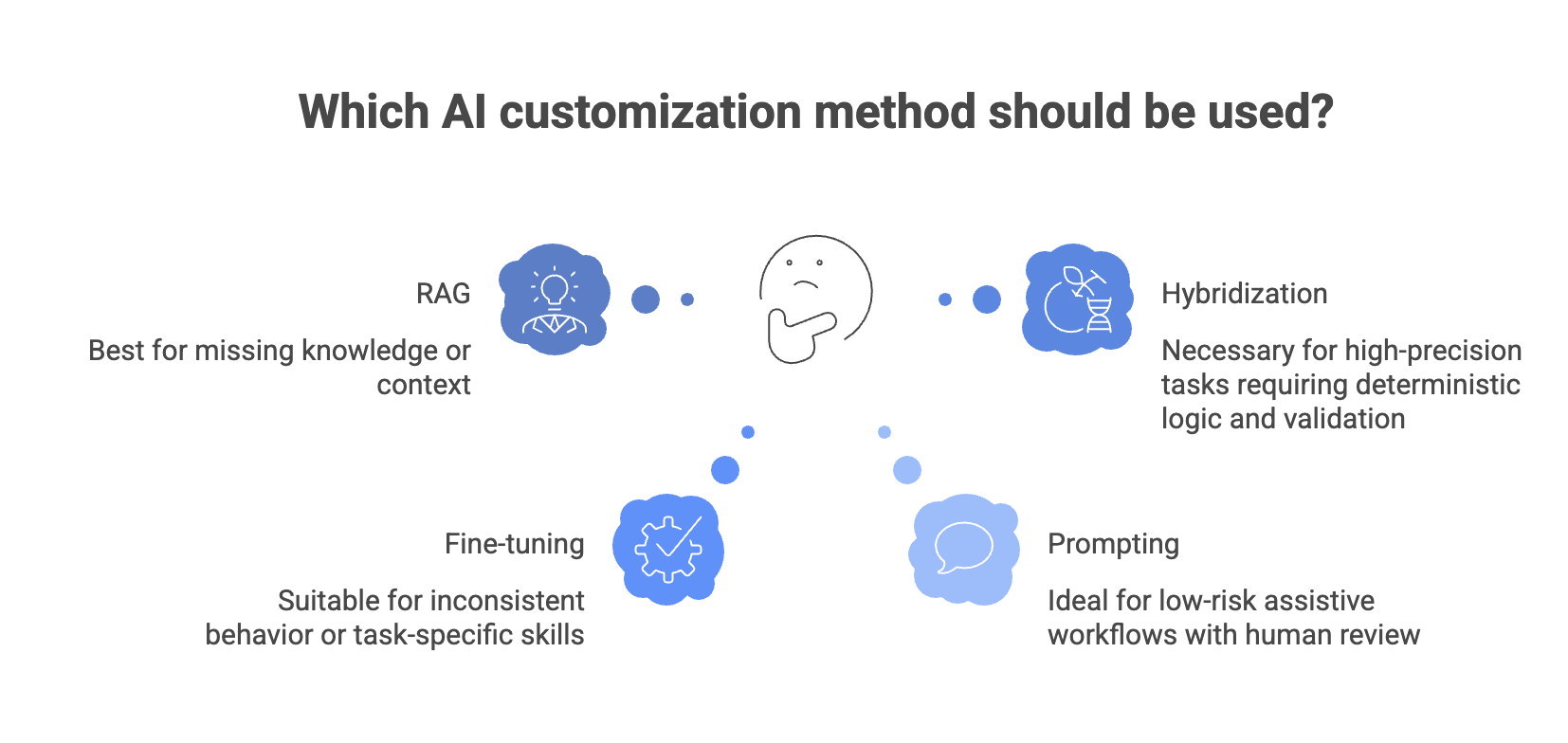
5) Choosing the right customization method: Prompting vs RAG vs Fine-tuning
Most GenAI customization falls into three approaches. Each is useful—but for different reasons.

6) A simple decision guide we use with clients
When deciding how to customize, we ask:
7) Production reality: “Trust but verify”
No matter which approach you pick, production GenAI requires discipline:
- Run the same prompt many times and measure variability
- Build a representative test set of real cases and edge cases
- Add structured output enforcement (schemas, parsers, validators)
- Monitor error and refusal rates, retrieval quality (for RAG), data drift
- Watch for overkill (too complex too early), bias in outputs, and model behavior changes after upgrades
This is what turns a demo into a dependable system.
A concrete example: “Customer Support Copilot” done right
Here’s what a decomposed, production-safe approach looks like:
- Deterministic data pull: account status, plan tier, device info, last ticket, relevant policy
- RAG retrieval: fetch the most relevant troubleshooting steps and policy constraints
- GenAI draft early: create a response draft + suggested next steps
- Validation checks: ensure no prohibited claims, confirm policy alignment, enforce tone/structure
- Human-in-loop: auto-approve low-risk cases; escalate sensitive/high-risk cases
- Audit trail: log sources used + final message + reviewer decisions
This structure avoids hallucination becoming customer-facing truth—and makes performance measurable.
The QubitNexus takeaway
Custom GenAI isn’t magic, and it isn’t just “connect an API.” It’s a system design problem:
- decompose the workflow,
- use deterministic pipelines wherever precision is required,
- place AI early and validate downstream,
- and choose prompting vs RAG vs fine-tuning based on what you’re really missing (context vs behavior vs scale).
That’s how you get real business impact without getting burned.