Forecast & Monitor
Establish localized demand baselines and continuously compare expected, planned, and actual sales.
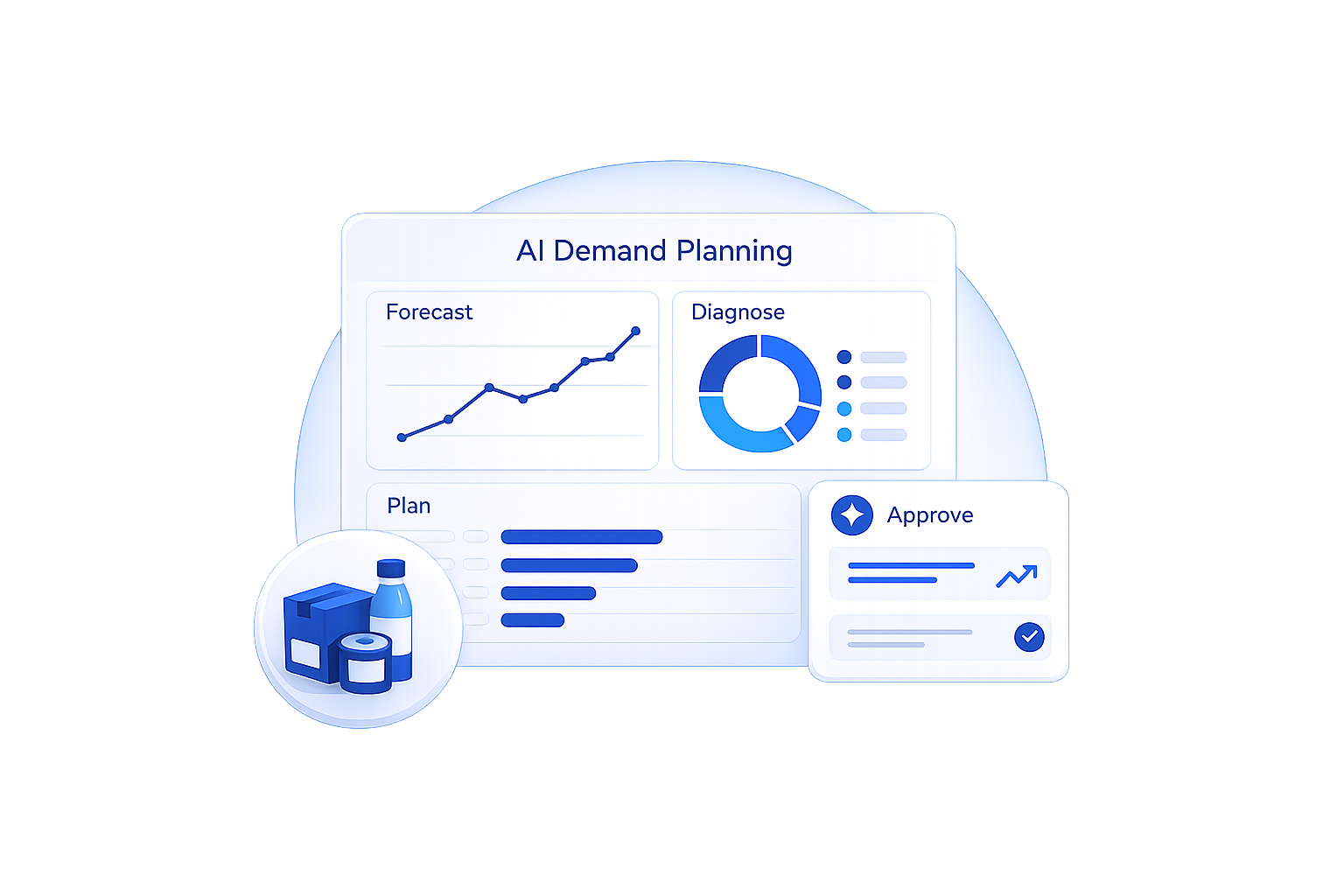
A continuous planning cockpit that helps CPG teams forecast demand, detect meaningful deviations, investigate what changed, simulate pricing and promotion scenarios, and decide what to do next — with the planner in control of every recommendation.
Establish localized demand baselines and continuously compare expected, planned, and actual sales.
Identify where demand changed and help planners explore product, customer, regional, promotional, weather, calendar, and market drivers.
Test pricing, promotion, distribution, and external-market scenarios and compare their expected effect on demand, revenue, margin, and risk.
Approve or modify recommendations, monitor actual outcomes, and preserve validated context for future planning cycles.
Most demand-planning teams are still trying to make fast decisions by manually reconciling spreadsheets, meetings, and disconnected tools. As pricing, promotions, availability, local events, weather, and competitive activity shift demand across products, customers, and locations, the forecast can become outdated before teams even agree on it.
The real challenge is not producing another forecast. It is understanding what changed, deciding how to respond, and keeping Sales, Finance, Marketing, and Operations aligned around the same current view.
Sales, pricing, promotions, distribution, inventory, and external signals are collected from separate systems and spreadsheets.
Planners create raw baseline forecasts and manually incorporate local knowledge, commercial assumptions, and expected market events.
Sales, Finance, Marketing, and Operations review different assumptions through meetings, emails, and disconnected files.
When actual sales differ from plan, teams analyze products, customers, regions, promotions, and possible external causes.
Alternatives are evaluated individually, while decisions, results, and business context are rarely preserved for the next planning cycle.
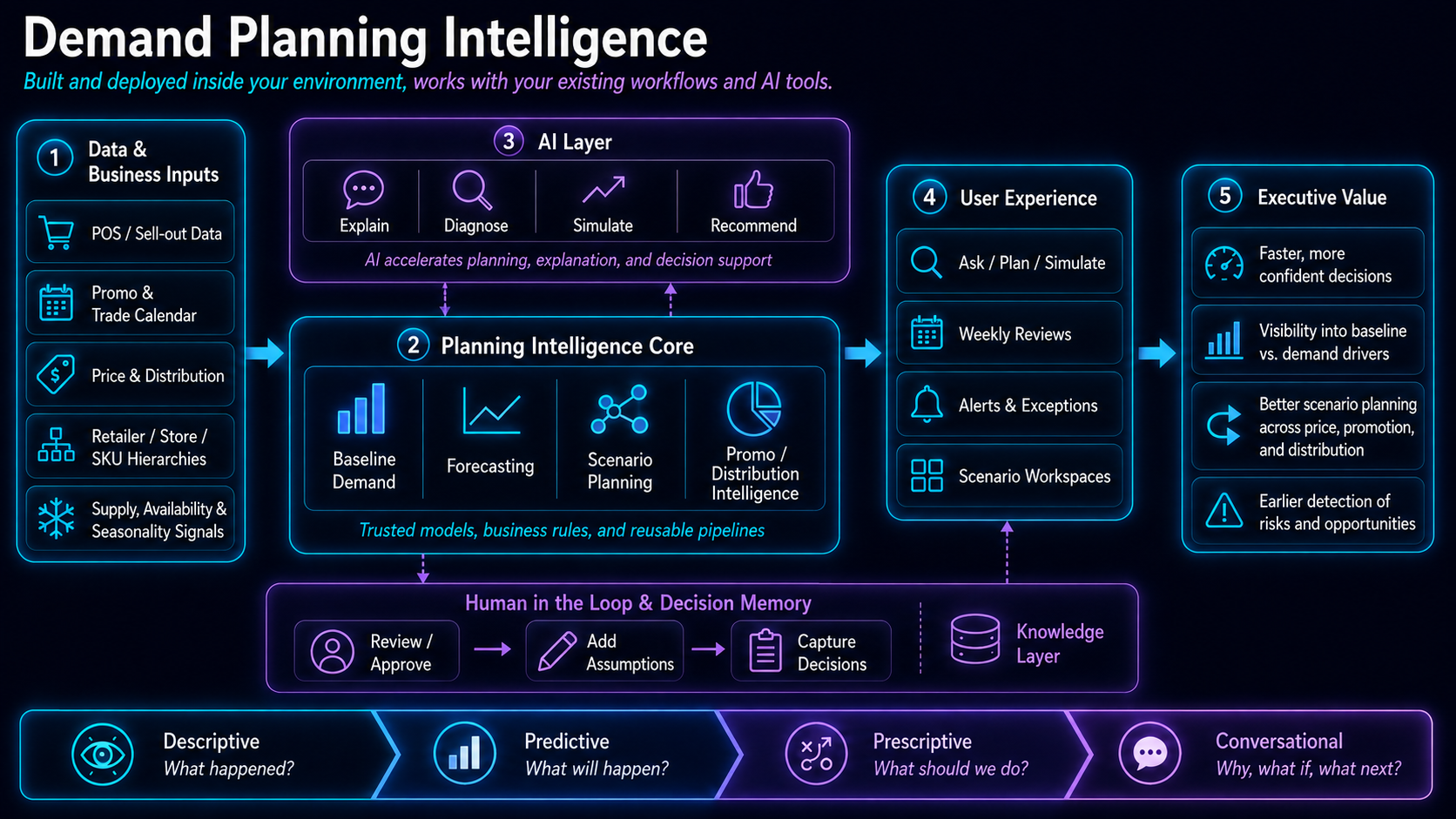
Connect approved sales, shipment, promotion, price, distribution, inventory, calendar, weather, competitive, and market information into a single trusted planning view.
Produce forecasts at the level where demand actually behaves differently: product, customer, channel, region, location or store cluster, and planning period.
Detect meaningful deviations from baseline, plan, or expected promotional uplift and help the planner determine what changed and where.
Change price, discount, promotion timing, distribution, market, weather, calendar, and other assumptions and observe projected outcomes on demand, revenue, and margin.
Present possible actions, supporting evidence, financial implications, confidence, and risks. The planner can approve, reject, or modify each recommendation.
Compare expected and actual demand, forecast accuracy, and realized uplift. Preserve validated explanations, outcomes, and planner comments for future use.
Provides baselines, forecasts, uplift estimates, scenario calculations, confidence ranges, forecast-error monitoring, and measurable outcomes.
Structures investigations, answers questions, explores connected data, explains findings, creates scenarios, retrieves prior context, and prepares recommendations.
Provides local knowledge, proposes unusual hypotheses, changes assumptions, evaluates recommendations, documents context, and retains final decision authority.
The operating model changes — not just the forecasting model. Planners shift from periodic, spreadsheet-based reconciliation to a continuous, evidence-backed conversation with their data, scenarios, and recommendations.
Quantified results will be added once outcomes are measured with a client. Until then, the impact story focuses on capability and operating-model change.
Start with a focused product, customer, category, or region and establish the baseline, data foundation, and planning cockpit.
Connect the existing models and tools into a monitoring, investigation, simulation, and recommendation workflow rather than replacing them.
Provide the architecture, reusable components, CPG analytics methods, AI orchestration, and implementation support needed to accelerate delivery.
Qubit Nexus helps CPG teams build AI-enabled demand planning and revenue management capabilities inside their own environment — connected to their data, models, planning workflows, business constraints, and existing technology stack.